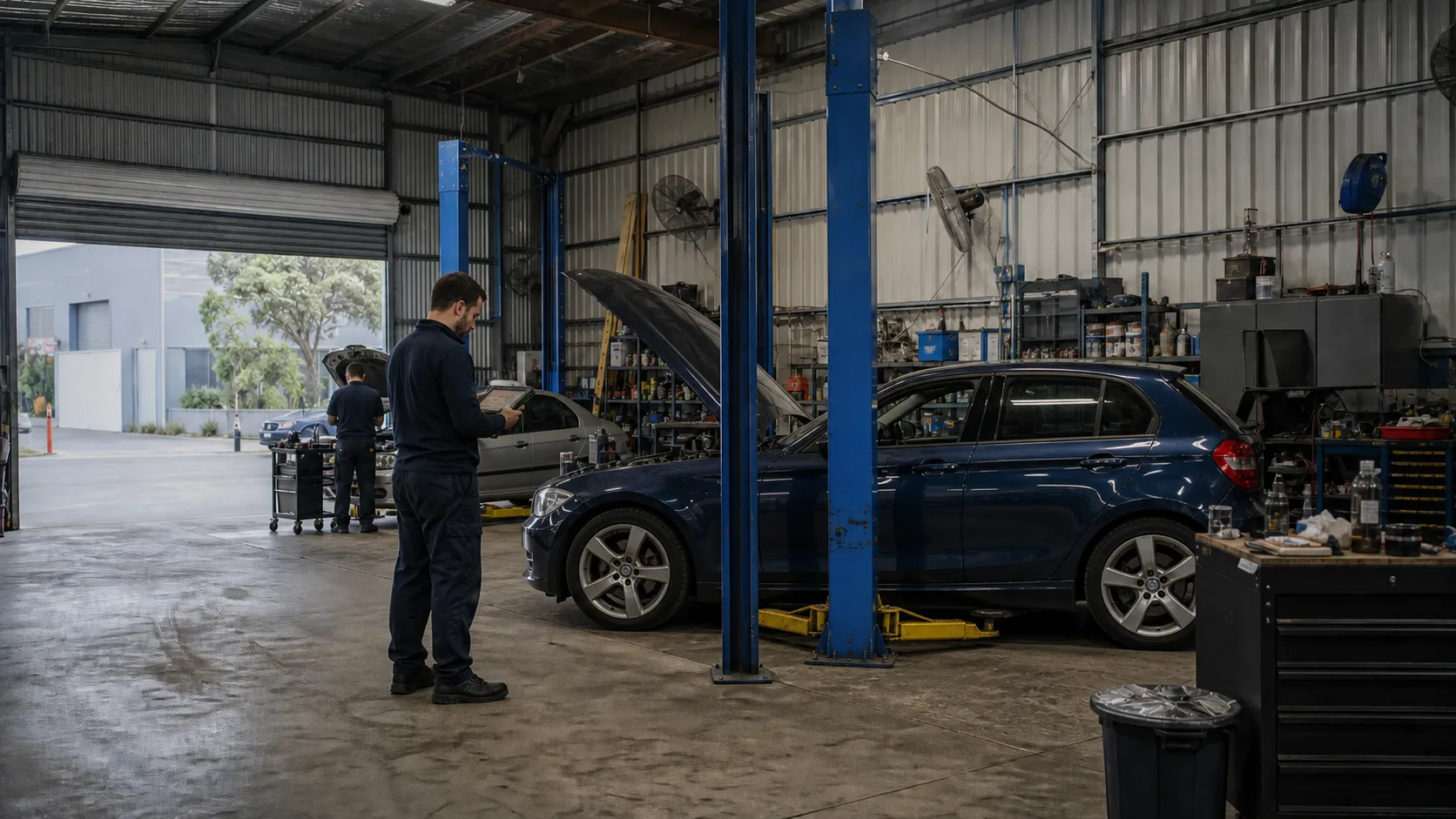
European car suspension inspection with the wheel removed in a Melbourne workshop

European suspension specialists Melbourne. Inspection first, then a written repair scope.

Suspension Repair Melbourne

Book suspension repairs, shock absorber and strut replacement, spring, bush and control arm work, air and adaptive suspension diagnosis, and post-repair wheel alignment for European and prestige vehicles in Melbourne. We assess the handling concern and the components behind it before confirming the repair scope, so the recommended work is based on the exact vehicle and the measured condition of its suspension, not an assumed shocks-and-springs package.

Car suspension repair for European vehicles Tell us the vehicle, what the suspension is doing and any dashboard message. The repair scope and the price are confirmed in writing after inspection.
01Comprehensive suspension inspectionComponent wear, ride height and the relevant system are assessed before replacement parts are recommended.
02OEM-Specification ComponentsDampers, springs, bushes, mounts and air-suspension parts matched to the exact model and suspension package.
03Electronic suspension consideredRide-height sensors, adaptive dampers, compressors and control modules can affect the diagnostic and repair process where relevant.
04Approval required before extrasAdditional findings explained and priced before further work.

Car suspension repair Melbourne

What a suspension repair involves, and why the cause comes before the parts

A suspension repair is not automatically a set of shock absorbers. A knock over bumps, a creak at low speed, uneven tyre wear, vague steering, a car sitting low and a ride-height warning each point to different parts of the suspension, and two of them can share a single cause. We identify the symptom, inspect the relevant components and assess actual wear before deciding what needs repair or replacement.

The right question is not “Do I need new suspension?” It is “What is causing the concern, and which components actually require attention?”
01

Vehicle identity

Make, model, build year, powertrain and suspension package determine the damper specification, spring rate, bush design and whether the car runs passive, adaptive or air suspension. A standard, sport, adaptive and air-sprung version of one model are four different repairs.


02

Measured wear and condition

Damper performance, bush and ball-joint play, spring condition, ride height at each corner and air-system pressure are assessed rather than estimated from kilometres.

03

Driving symptoms

What you hear or feel, at what speed and over what kind of surface, tells us where the inspection should start. A knock only over speed humps and a knock only on turning are different investigations.

04

Dashboard information

Suspension, ride-height, adaptive-damper and chassis warnings are copied exactly, because different warnings call for different checks.

Complete suspension system servicing

What is included in a suspension repair for a European vehicle?

The work depends on what the inspection finds. The written scope separates components that need attention now, parts that remain serviceable and faults that need further diagnosis.

01

Suspension inspection and measurement

Dampers, springs, bushes, ball joints, mounts, anti-roll bar links and ride height may be assessed as relevant to the vehicle and the reported concern. A road test over different surfaces is usually part of the inspection, because some suspension faults only appear under load. Developing wear is often picked up earlier during a scheduled logbook service, before it becomes a noise.

Ask about this item
02

Shock absorber and strut replacement

Dampers are matched to the vehicle’s specification and suspension package. On many European models the damper is supplied as part of a strut assembly with the spring, top mount and bearing, and where that applies the scope says so rather than quoting a bare damper.

Ask about this item
03

Spring and coil replacement

Spring condition, corrosion and breakage are checked, including the lower coils where grit and moisture sit after wet weather. A broken spring can present as a knock, a sitting-low corner or a tyre rubbing under compression.

Ask about this item
04

Control arms, bushes and ball joints

Control arm bushes, anti-roll bar bushes and links, ball joints and subframe bushes are assessed for play, perishing and separation. Where the manufacturer supplies the bush separately it can be replaced on its own; where the design only supplies a complete arm, the scope explains which applies to your vehicle.

Ask about this item
05

Air suspension and adaptive damper diagnosis

Air springs, compressors, valve blocks, lines, accumulators, ride-height sensors and adaptive damper valves can be tested where the vehicle is fitted with them. Systems such as Mercedes-Benz AIRMATIC, BMW adaptive and rear air suspension, Audi adaptive air suspension, Porsche adaptive and air suspension and Land Rover air suspension are diagnosed as a system before individual components are proposed, because a leak, a sensor fault and a failing compressor can all produce a car that sits low.

Ask about this item
06

Wheel bearings, mounts and driveline noise

Wheel bearings, strut top mounts and bearings, and engine and transmission mounts are checked where the symptom suggests them. Mount wear is frequently reported as a suspension problem because it transmits vibration and clunk into the cabin in a similar way.

Ask about this item
07

Steering components

Tie rod ends, rack condition, steering joints and play through the wheel are assessed where the concern includes wandering, vagueness or a clunk felt through the steering. Steering and suspension wear often present together and are inspected together.

Ask about this item
08

Wheel alignment after suspension work

Alignment is identified as a required step where the repair has disturbed a geometry setting. Replacing control arms, tie rods, springs or struts changes camber, caster or toe on most European platforms, so where alignment is required it is set out and priced in the written scope rather than left as an unpriced extra. Where a vehicle carries driver-assistance cameras or radar, any manufacturer requirement for recalibration after geometry or ride-height changes is identified before the work is booked.

Ask about this item

Why a suspension concern should not wait

What a postponed suspension repair can turn into

Suspension usually degrades gradually, and that is what makes it easy to live with. Booking the inspection early is what keeps the repair small, the written price clear and the choice of components yours, and on Melbourne’s tram tracks, speed humps and patched arterials a suspension concern rarely settles down on its own.

Book a suspension inspection
01

Handling changes before the noise does

Damper performance, bush condition and spring height all affect how the car holds a line, stops and corners, and they change slowly enough to feel normal. Assessment is what separates suspension with useful life left from suspension that is past its limits.

02

One worn component wears the ones next to it

A perished bush lets a control arm move outside its designed path, which loads the ball joint, the damper and the tyre beside it. Booking while the complaint is still a single noise is what keeps a suspension repair to the smaller of those two jobs.

03

Tyres record the problem permanently

Worn suspension and disturbed geometry wear tyres unevenly, and that wear does not reverse once the suspension is fixed. A set of European tyres scrubbed on the inner edges can end up costing more than the worn bush that caused it.

04

Air suspension faults can escalate while the car still drives

A small air leak makes the compressor run longer and more often, and a compressor working against a leak is doing work it was not designed to do. Finding the leak early is usually a smaller repair than the compressor that follows it.

05

An early inspection keeps the repair on your terms

Suspension checked while the car is still comfortable leaves room to read an itemised written price, order the correct components for the exact model and book a time that suits you, rather than taking whatever is available after a warning message or a failed roadworthy.

Suspension warning signs

Common suspension symptoms and what they can point to

These signs tell us where to start. None of them is a diagnosis until the car has been inspected.

A ride-height warning, a sudden change in handling or a loud suspension noise should not be diagnosed from the symptom alone. Share the exact message and what the car is doing when you book, and tell us if you are unsure whether the car is safe to drive.
01

Knocking or clunking over bumps

Commonly anti-roll bar links, control arm bushes, ball joints or a strut top mount, and sometimes a broken spring. A knock that appears over speed humps but not on a smooth road usually means a component with play rather than a worn damper.

02

Creaking or squeaking at low speed

Often perished rubber bushes working dry, which Melbourne’s wet winters and short inner-suburb trips tend to accelerate. Creaking that changes with steering input points somewhere different from creaking that only happens over a driveway.

03

Uneven or feathered tyre wear

Wear on the inner or outer edge, or a feathered pattern across the tread, usually means geometry outside specification or a worn component allowing a wheel to move. Because the same pattern can come from alignment alone or from a failed bush, the cause is confirmed before parts are proposed.

04

The car sitting low, unevenly, or refusing to raise

On air-sprung models this can be a leaking air spring, a line, a valve block, a sensor or a compressor that can no longer hold pressure, and it is often accompanied by a ride-height message. On coil-sprung cars a corner sitting low is more often a broken spring or a collapsed mount.

05

Wandering, vague or heavy steering

Worn tie rod ends, control arm bushes, a steering joint or geometry out of specification can each make a car follow road camber or feel unsettled at highway speed. Steering and suspension components are inspected together because they share the same wear paths.

06

Continued bouncing, nose-dive or body roll

A car that keeps moving after a bump, dips sharply under braking or leans more than it used to is usually losing damper control. Where the vehicle has adaptive dampers, an electronic fault can produce the same feel as a mechanically worn unit, so the system is tested before dampers are quoted.

07

Vibration at speed

Wheel balance, tyre condition, a wheel bearing, worn suspension and brake components can all produce vibration, and more than one of them is often present. Vibration felt through the brake pedal is assessed differently from vibration that is constant at a given speed, which is why a shudder that only appears under braking is investigated alongside the brake system.

European & prestige brands serviced in Melbourne

European car service for Audi, BMW, Mercedes-Benz and more

Correct suspension work starts with the specification, geometry data and diagnostic system for your marque. Select your vehicle brand to start a tailored service or repair enquiry.

Air and adaptive systems vary widely between these marques, and a ride-height complaint on an AIRMATIC car is a different investigation from the same complaint on a coil-sprung one, which is why Mercedes-Benz suspension work is quoted against the specific system fitted.

Melbourne driving conditions and your rights

European suspension, Melbourne roads and independent repair

Melbourne driving is hard on European suspension in specific ways, and Victorian roadworthy rules treat suspension and steering defects seriously. You are also entitled to have the work done independently. Current ACCC guidance says consumers can choose an independent repairer and that manufacturers must make service and repair information available. The work still needs the right parts, specifications, geometry data and records.

Read ACCC car guidance
01

Tram tracks, bluestone and inner-suburb surfaces

Sydney Road, Brunswick Street, St Kilda Road and the laneways around them put repeated sharp impacts through bushes, ball joints and top mounts. Low-profile tyres on large wheels pass more of that impact into the suspension than a taller tyre would.

02

Speed humps and patched arterials

Inner and middle suburbs are full of speed humps, and wet winters leave arterials patched and uneven. Repeated low-speed compression is what tends to find a tired bush or a failing anti-roll bar link.

03

Expansion joints and long freeway runs

The Monash, Eastern, Tullamarine and Western Ring Road mean sustained running over regular joints. That is comparatively easy on components but it is where a worn damper or an out-of-specification geometry setting shows up as wander or uneven tyre wear.

04

Weekend drives and unsealed roads

The Dandenong Ranges, Black Spur, Great Ocean Road and the gravel approaches to Yarra Valley and Mornington Peninsula properties load suspension differently again, with sustained cornering and corrugations rather than single impacts.

05

Roadworthy and defect notices

Suspension and steering are listed items in a Victorian roadworthy inspection. Excessive play in a ball joint or bush, a leaking or ineffective damper, a broken spring or a suspension component that is damaged or insecure can fail a roadworthy certificate or attract a defect notice.

06

Keep evidence of the work

Retain the invoice showing the parts fitted, the measurements taken, the alignment report and the date. It supports warranty claims and the next buyer’s confidence in the car.

Suspension repair cost Melbourne

What decides the price of a suspension repair in Melbourne

A pair of front dampers, a single control arm bush, a broken spring, an air-suspension leak and an adaptive-damper fault are different jobs at different prices, and on European cars the suspension package can change between variants of the same model. These are the factors that move the number, and the figure you receive is itemised in writing after the suspension has been inspected.

01

The exact vehicle and suspension package

Passive, sport, adaptive and air suspension are different systems with different parts, and they appear across variants of a single model. An M Sport, AMG, S line, Dynamic or air-sprung version is not priced from the model name. The exact vehicle, build year and VIN are what make a suspension quote accurate.

02

Which corners the work covers

Suspension is usually quoted per axle or per corner. One lower control arm, both front dampers, or a full set with springs and mounts are separate prices, and the inspection identifies which of them the car actually needs.

03

Whether the component comes on its own or as an assembly

Some bushes press into an arm; others are only supplied with the arm. Some dampers fit alone; others come as a strut assembly with the spring, mount and bearing. What the manufacturer supplies for your model has a large effect on the price, and the scope states which applies.

04

Air and adaptive system components

An air spring, a line, a valve block, a ride-height sensor, a compressor and a complete air strut are very different costs. Diagnosing which of them is at fault before anything is ordered is what keeps an air-suspension repair from being quoted as a whole-corner replacement.

05

Diagnostic time, press work and alignment

An electronic suspension fault has to be read and interpreted before parts can be quoted, bushes that must be pressed take more workshop time than a bolt-on part, and alignment after the repair is quoted rather than assumed.

06

Parts specification

Genuine or equivalent components matched to the vehicle. Where there is a choice between standard, sport and aftermarket options, the differences in ride, longevity and price are explained before anything is ordered.

07

Comparing suspension prices like with like

A cheaper suspension quote often covers less work. Check whether it includes springs, mounts and bearings with the dampers, whether bushes or complete arms are quoted, whether alignment is included, and how anything found during the repair is approved and priced.

Request an itemised suspension price

Suspension repair process

From suspension symptoms to a clearly defined repair

Good suspension work starts before the car arrives. Accurate details help us allocate time, source the right parts and avoid comparing quotes that cover different repairs.

The inspection identifies the concern. The written scope defines the work you approve.
01

Send the vehicle details

Provide the make, model, year, powertrain, VIN or registration, the symptom, the surface it happens on and any dashboard message.

02

Inspect, road test and assess

Dampers, springs, bushes, joints, mounts and ride height are inspected and road tested, and air or adaptive systems are scanned, to identify what actually needs attention.

03

Approve the written price

Included components, labour, alignment and exclusions are set out in writing before repair work proceeds.

04

Complete the approved suspension repair

The approved work is completed, geometry is reset where the repair required it, and the car is road tested. Any further findings can be discussed before additional work proceeds.

Book suspension repair Melbourne

Book suspension repairs or request a written price

Use the booking form when the vehicle needs workshop time. Choose general enquiry for pricing questions, capability checks or help working out whether a symptom is urgent. Drivers come to us from across Melbourne, including those who reach us through the workshop’s Moorabbin service area.

Suspension repair booking request

Tell us about the vehicle.


Suspension repair Melbourne FAQs

Suspension repair questions answered clearly

These answers explain how suspension concerns are assessed and priced. The exact vehicle, its inspection findings and the written scope remain the relevant source for an individual booking.

It depends on the vehicle, the components and what the inspection finds. A single anti-roll bar link, a pair of front dampers, a pressed control arm bush, an air-spring leak and an adaptive-damper fault are very different jobs, and European suspension packages vary between variants of one model. We give you an itemised written price after inspection, so you are comparing like with like.

Uneven tyre wear and a car that pulls can come from geometry alone, or from a worn component that is letting a wheel move. Alignment cannot hold its settings on worn suspension, so the components are assessed first and the geometry is set afterwards. The inspection tells you which of the two you are dealing with.

Replacing dampers in axle pairs is the usual recommendation, because a new damper on one side and a worn one on the other give the axle uneven control. Where only one unit has failed, for example after damage or a leak, the options and the handling trade-off are explained before you decide.

It depends on which part has failed. Air springs, lines, valve blocks, sensors and compressors are often available and replaceable individually, and on some models the air spring is supplied separately from the damper. The system is tested to locate the fault before any component is proposed, because replacing a complete corner is not always the repair the car needs.

It depends entirely on what is knocking. Some noises come from components with minor play that can be monitored; others, such as a separating ball joint or a broken spring, affect control of the vehicle. A knock that has appeared suddenly, changed character or is accompanied by a handling change should be checked straight away and driving kept to a minimum.

It can. Suspension and steering are listed items, and excessive play, a leaking or ineffective damper, a broken spring or an insecure component can each be grounds for failure. Having the suspension assessed before the inspection is usually cheaper than a retest.

Suspension repair Melbourne

Request an itemised suspension repair price

Share the exact vehicle, what the suspension sounds or feels like and any dashboard message so the workshop can confirm the repair scope in writing.

Request an itemised suspension price Ask a question
Ask Service quote